by Carmen L. Petit and Sabina Vaught
the flood hiding in stone
will roar
~ “Another Death,” Ghassan Zaqtan
In the catastrophe of modernity (Alagraa, 2021; Maldonado-Torres, 2021) floods are raised as a spectral threat to “civilization.” However, the flood (though sometimes catastrophic to living beings) is never the original catastrophe. Whether the flood takes the shape of scriptural or origin story, climatological event, state and corporate terrorism against occupied peoples, or armed resistance, it is the response to or the weapon of the unparalleled catastrophe of empire, of western civilization. In this moment, we are most interested in the flood as a capacious counter-catastrophic metaphor—as resistance. As resistance metaphor, the flood links liberation struggles globally, drawing from knowledges that precede empire’s brutal, brief reign (Robinson, 2000), and offer a porthole/portal to their beyond-empire possibilities. But in the meantime, the levees also break, and the dams are closed, letting loose genocidal floods. How we drown or float or journey is in part a question of analytic solidarity.
In this article, we explore a metaphorical analytic solidarity that emerges through artists in occupied contexts who create work that ushers in the flood. Whether these artists furnish anti-colonial canoes for our collective navigation, or cinch the historic and the contemporary floods into a confluence of resistance, their works are pedagogical paradigms that allow us to imagine and build anticolonial movement through the tool of metaphor. And as with rivers that flow freely to the sea, this essay picks up and drops off travelers and cargo, catches various currents, encounters fragments, and erodes fortresses as it moves along. We begin with a conceptual solidarity framework of struggle and metaphor, dialogically anchored in the thawabet. From this framing we consider the pedagogical analytic methodology of the long anti-colonial traditions of thinking and creating dangerously. We surface the emergent complexities of this analytic possibility through works by artists Jaune Quick-To-See Smith, Jim Denomie, and Dima Srouji, as well as other examples of material, expressive culture.
The Thawabet, metaphor, and a conceptual frame of struggle
The flood (see: note 1), as Palestinian metaphor and materiality of resistance, impels us to study the purpose and function of metaphor itself. How do certain Palestinian metaphorical sensibilities refute the jarring imperial bifurcation of metaphor and materiality (as if the two are not interknit as breath and blood)? The metaphor and the material swirl in eddies and crash in waterfalls. In keeping with the theme of this special issue, we consider that there are Palestinian metaphorical sensibilities that carry the principles of the thawabet. On October 7 of 2010, Palestinian journalist Hazem Jamjoum published an interview in the Electronic Intifada with Bilal Al-Hassan, which focuses on the thawabet. Jamjoun initiates this interview with a definition of the thawabet:
The thawabet are not just a vague group of ideas to be interpreted at will, but in fact constitute the inalienable rights of the Palestinian people. These include: the right of Palestinian refugees to return, restitution and compensation; the right to resistance in all of its forms; and the right to self-determination over the British Mandate territory of Palestine, from the Mediterranean to the Jordan River.
As Bilal al-Hassan says in this interview, the thawabet, stretching from the river to the sea, are as old as the struggle and are the vessel of the liberation journey.
One aspect of the thawabet is that they emerge from the history of our struggle…As a people rejects, it struggles, with or without arms. The Palestinian people struggled against colonialism…So colonialism creates anti-colonial struggle, and so the right to resist and the right to self-determination become part of the thawabet.
While all liberation struggles must shift over time, thawabet are principled constants that constellate the ongoing materialization of the struggle.
We are interested in the metaphorical (which, we argue, are material) ways the thawabet are expressed, particularly within artistic practices that surface from the deluge of occupation and genocide. Specifically, we engage a myriad of artists, and traditions of making, as one practice of metaphorical analytic solidarity, and consider how our work might be guided by those expansive pedagogical expressions. “We are in a new territory now,” writes Isabella Hammad (2024), 9 days before Tufan Al-Aqsa, the flood. “The Palestinian struggle for freedom has outlasted the narrative shape of other anticolonial liberation movements that concluded with independence during the twentieth century, and it is becoming more difficult to hold fast to the old narratives about the power of narrative” (31). What does this narrative and the geo-temporality of struggle entail and how can its dexterous metaphorical expressions shape the currents of our pedagogy: visual, oral, and textual storytelling? Palestinian poet and intellectual Mahmoud Darwish (2009) catalyzes our thinking as we consider this compelling question.
The metaphor entices you to break away from it and look at the empty sky, like a blue desert without a mirage to be seen. Then the metaphor calls you back to its source and you cannot find a way through the clouds…You are reluctant to emerge from the metaphor in case you fall into the well of loneliness. (54)
Calling back to the source: Methodologies of materiality & metaphor
Twenty years ago Teresia Teaiwa invited us into the canoe that is the Pacific Studies classroom (2021). She gifted that seemingly simple pedagogical metaphor with extraordinary and sustained capacity and with stretch to other areas of study and instruction. Specifically, she unmoored the canoe to both rebut notions of expertise (which, she insists, are impossible in Pacific Studies and which, we add, are important for us to avoid in our stance of solidarity) and to metaphorically, materially express the collaborative essence of an anticolonial pedagogy. The canoe as pedagogy bears as its central relationality an axial interdependence of people: their knowledges and their expression of knowledges. The canoe traverses waterworlds and surfaces solidarities: “A stranger on the riverbank, like the river…water/binds me to your name” (Darwish, 2008, 89). That metaphor—of the canoe and its travels, rowers, cargo—ripples across time, its wake a confluence with the flood, enticing us to break away from the stifling sterility of colonial metaphors stripped of their materiality and calling our attention to the metaphors animated in the material by global peoples. The canoe is a material relational subject that holds and expresses the life of metaphor.
From across the riverbank, living on another shore of the sea, the canoe helps us think about what it means to navigate the flood. Inherent to the thawabet is that we must imagine what it means to ride the currents of the flood. The canoe is a metaphorical practice and practice of metaphor. The canoe asks us: Who is in it with us? Who is invited? What are we meant to learn? To teach? What is exile? Who is exiled? And, what is belonging and who belongs? What are our responsibilities and roles? How do we account for cross-currents? Through these questions, in the spirit of thawabet and drawn from Pacific Studies, we take up Cesaire’s (2000) charge to approach our analyses of colonization and western civilization with clarity: “the essential thing here is to see clearly, to think clearly—that is, dangerously” (p. 32). As Hammad (2024) argues, the Palestinian narrative does not resolve. Its questions remain deliberately unanswered. So, to think dangerously means, to us, to think metaphorically. To live metaphorically in the unresolved, the always moving, roiling, and rushing. In the same breath as thinking dangerously, we understand the metaphor to guide us to “create dangerously” (Danticat, 2010), a merging of thought and creation and a refuting of practices of colonial Cartesian splits. In the canoe or on the shore witnessing its journeys, we consider the liberatory confluence of teaching, telling, recalling, and creating stories: stories that intertwine seemingly distant struggles; stories that are dangerous. This is the materiality and metaphor of solidarity. So, the canoe is an example of how people might mobilize metaphor as the very practice of solidarity with the thawabet.
What are the materialities of creating and thinking dangerously? Considering the violently repressive Haitian regime of the 1960s, Edwidge Danticat (2010) describes how people creatively (dangerously) resisted. Against the backdrop of the brutally spectacular public theater of the hanging of two young insurrectionists, Numa and Drouin, Danticat narrates how groups of people—including her own family members—sustained their own resistance. In part, they read Albert Camus (among many others) and dramatically reenacted his texts. These readings and reenactments were the theater in which they laid the pedagogical groundwork for liberation, crafting metaphorical or symbolic conversations, creations, study, other worlds, and, ultimately, rebellion. Haitian people created dangerously in this way, metaphorically fomenting the principles and commitments of liberation much like the thawabet.
As with Palestinian liberation, Danticat writes that the people of Haiti “needed art that could convince them that they would not die the same way Numa and Drouin did. They needed to be convinced that words could still be spoken, that stories could still be told and passed on” (8). This resonates with artistic movements in Palestine. In 1968, Sulafa Jadallah, Hani Jawharieh, and Mustafa Abu Ali, came together to create a cinematic auxiliary of the Fatah, the Palestine Film Unit (PFU). As their manifesto reads:
Militant Palestinian cinema must find new tools and frameworks capable of capturing the glorious struggle of the Palestinian people. The peoples’ cinema must express the peoples’ war…The value of a militant film is measured by its benefit to the revolutionary cause of the film. (Habashneh, 2023, 150)
Indeed, we draw from the PFU’s position that it is from the metaphors of art that we might locate and practice dangerous and militant pedagogical solidarity practices. Importantly, the metaphor allows for pluriversal movement toward liberation (Grosfoguel, 2011): the allowance for many ways within and across many liberation cosmologies and materialities. Metaphor allows us to infuse oral and visual signifiers with multiple, insurgent, and dialectical meanings that share a cause of liberation but are not forced into a singular, didactic vision or process. So, in what follows, we look to the liberatory principles of resistance and return embedded in artistic visual metaphor.
Return to sender: Art and the pedagogy of sending death back
Reflecting on the relationship among repression, creation, and liberation, Danticat quotes Camus: “‘Art cannot be a monologue. We are on the high seas. The artist, like everyone else, must bend to his oar, without dying if possible’” (2010, 13). Art in dangerous times helps us understand that, as Teaiwa says, anticolonial movement (and its pedagogical thrust) is collective. So, stepping off the riverbank with Darwish, into a canoe with Teaiwa and Camus, we set off with Danticat’s nautical chart toward the sea, riding the rising and receding flood of Palestinian metaphor, imagining a new tidalectics of solidarity (Brathwaite, 1988).
We now consider a specific canoe—one whose shape, form, and content serve as dynamic mimetic relative to Teaiwa’s classroom-canoe, or canoe-classroom. This canoe is the late and revered artist and curator Jaune Quick-to-See Smith’s (citizen of the Confederated Salish and Kootenai Nation) painting, Trade Canoe for Don Quixote (2004). And although it is a specific canoe, its materiality is a metaphor that links liberation struggles across war contexts, redirecting and reclaiming the journey.
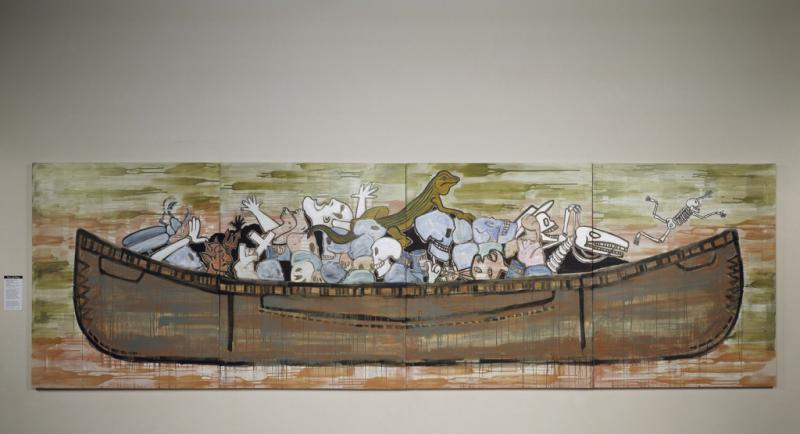
Stretching across four panels is the image of a traditional birchbark canoe of the Anishinaabe and other Indigenous peoples of Turtle Island. It floats or sits within an amorphous and unspecified landscape or waterscape with streaks of paint traipsing across each panel in all four directions, upending the very sense of singular direction and destination for the viewer. Its cargo is a chaotic pile of grisly figures, beckoning the viewer to look more closely.
“My best hope,” says Jaune Quick-to-See Smith,
is that a viewer sees something about the human condition, that might cause them to pause a moment and consider something like war…[The painting] moves the trade canoe to a more massive war canoe such as the ocean going canoes on the Pacific Rim. Besides the wars in the Middle East, perpetrated by the U.S., there are other issues that are fought politically in a war-like way. These issues might be as varied as a woman’s right to choose for her own body; healthy natural foods versus unhealthy processed foods that are controlled by massive corporate campaigns; the consumer culture issues which are controlled by international corporations versus living in a sustainable way … Can we trade all this for peace, respect, kindness, friendship, sustainability, and a caring for our planet and all its inhabitants. (Trade Canoe for Don Quixote, n.d.)
In the creation of this trade canoe, inundated with war and death, with global imperialism, capitalism, and ecocide, Quick-to-See Smith is delivering the contents, the cargo, somewhere else for something else. That somewhere else might require us to steer our canoes into the flood, beyond the “desert mirage of water,” (as Quick-to-See Smith describes the canoe’s background) to embark on a returning, return journey with that new cargo—which she outlines as a world predicated on symbiotic obligation to others. In this way the Palestinian pedagogy of metaphor (and the Palestinian metaphor of the flood) is the carrying force, propelling us forward to global Indigenous liberation anchored in place: our line of questioning then becomes, is this place a singular somewhere or an everywhere somewhere? It is an unresolved and yet steadfast narrative.
The capacity of the artist then bridges the metaphor and materiality of repression and revolution, the constants of resistance and return. Quick-to-See Smith animates this role of the artist and art in linking global regimes of power and, more importantly, the interdependent somewheres of liberation. Danticat (2010) writes that the immigrant (and we add, exiled, occupied, displaced, Indigenous, and/or diasporic)
artist shares with all other artists the desire to interpret and possibly remake his or her own world. So though we may not be creating as dangerously as our forebearers—though we are not risking torture, beatings, execution, though exile does not threaten us into perpetual silence—still, while we are at work bodies are littering the streets somewhere. People are buried under rubble somewhere. Mass graves are being dug somewhere. Survivors are living in make-shift tent cities and refugee camps somewhere, shielding their heads from the rain, closing their eyes, covering their ears, to shut out the sounds of the military ‘aid’ helicopters. And still, many are reading, and writing, quietly, quietly (18, italics ours).
And yet, we understand the pedagogical uses of Palestinian metaphor to implore us to never understand Palestine as simply somewhere else, but rather to understand Palestine itself, the people, land, skies, and water, as the metaphor for the conditions of both life and death, there and everywhere else. As June Jordan (2005) writes, we become Palestinian as an act of collectively creating global space for living and life. So, the somewhere is everywhere. In this, we can locate the shared pulse of seemingly disparate struggles and resistance movements, not through collapsing peoples and places, but rather through linking undercurrents that emerge in these anticolonial artworks.
That somewhere, then, is a metaphor of Palestine and its material obligation to resist until liberation everywhere; to enact the global Indigenous right to return, and the global Indigenous right to “resistance in all its forms.” As Quick-to-See Smith fills her trade canoe with death and violence and war, she mobilizes “trade”—simultaneously a euphemistic european frame for genocidal capitalism, a pre-colonial practice of socializing resources, and an insurgent convention—as militant resistance. The boat is on its way—in, and through, four directions. The canoe will deliver the cargo (some of which she depicts through a trickster methodology by mimicking western anti-war art) (see: note 2) of death, war, colonialism, and imperialism back to their source in exchange for the stolen goods of non-colonial life, without the agreement, treaty, or decree of the colonial nation state or institution or agent, without the negotiation of the oil company, arms makers, or militaries.
We observe this metaphorical practice of pedagogically returning death and destruction to its colonial origin through multiple Palestinian material formations. We see it in the image of Edward Said throwing stones with comrades against occupying forces (Goodman, 2001) or Refaat Alareer brandishing his expo marker (Abunimah et al., 2023) or various armed resistance organizations returning the weaponry of death, aimed unilaterally, ceaselessly at their Homelands for decades, by reconfiguring it into liberation arsenals.
What will the trade canoe return with and to what somewhere?
Drowning and resurfacing in exile
Twenty years ago, shoddily constructed levees broke or were blown up or somehow did what the U.S. Army Corps of Engineers ensured they would do: fail. The wake of Katrina flooded ward after ward, parish after parish, submerging traditional centers of Black expressive, epistemic life.
Almost seventy years ago,
on the morning of March 10, 1957…the massive steel and concrete gates of The Dalles Dam closed and choked back the downstream surge of the Columbia River. Four and a half hours later and eight miles upstream, Celilo Falls, the spectacular natural wonder and the age-old Indian salmon fishery associated with it, was under water (Celilo Falls, n.d.).
Constructed by the U.S. Army Corps of Engineers, the dam choked Nchi Wana (the Columbia River) and drowned Wy-am (the falls and the village attached to it)—an epicenter for Indigenous diplomacy, trade, relationality, and knowledge sharing (K. Farrell-Smith, personal communication, 2024) (see: note 3). This flooding by the occupation also submerged art: petroglyphs and pictographs (see: note 4).
The United States occupation’s genocidal employment and state-mechanized activation of the flood is naturalized in part through its discursive and ideological campaign to frame the nation-state as protector and guardian of its subjects from the flood—in effect, separating people from water and land as though floods are external threats rather than state technology of war. In fact, the Department of Homeland Security asserts responsibility for, amongst cybersecurity threats and immigration, the nation’s response to floods (E. C. Williams, personal communication, 2025; Secretary for Homeland Security, 2025)
Arising here are multiple mechanizations of the flood. Wy-am and Katrina demonstrate for us the violence in the lack of liberatory metaphor. The metaphor’s absence defangs and nullifies the mechanization of the flood as state violence and in fact positions the state as an essential security structure from and against the flood, from naturalized horror (which it in fact creates):
Flooding is a leading cause of fatalities and economic losses in the United States, especially as a result of natural disasters. New and emerging technologies are needed to increase the resilience of communities to flood disasters and to provide flood predictive analytic tools to the Federal Emergency Management Agency (FEMA), state, local, tribal, and territorial (SLTT) governments to reduce future flood fatalities and resulting economic damages. (U.S. Department of Homeland Security, 2025)
If the flood is reduced to abjectly normalized fact, to be protected from by the colonial state’s security apparatuses, rather than a subject with relational speculative liberation capacities, not only are people dammed from the pedagogy of total life relations but also from a material anticolonial analytic. The metaphor is the material.
That metaphorical analytic invites us to revisit Celilo Falls and to be curious about the deliberate submersion of living ontologies, and in particular their visual form and core: art; here in the tradition of petroglyphs or pictographs. When the dam walls were sealed—like the monstrous gates of the colonial fortress—and the collective life of Wy-am was drowned in the name of economic prosperity and the development of the occupying nation’s trade routes and technological control of water, the visual stories and living spirits that had spanned the bluff and cliff sides of the Columbia River Gorge were also drowned (Robinson, 2019). Drowned because their evidence, their literal mark on the land, is positioned as dangerous to the anti-metaphorical colonial monologue (Danticat, 2010; Pexa, 2019).
“I want to remind us all that art is dangerous,” said Toni Morrison at the Art and Social Justice talk (Morrison, 2016). “I want to remind you of the history of artists who have been murdered, slaughtered, imprisoned, chopped up, refused entrance. The history of art… has always been bloody because dictators and people in office and people who want to control and deceive know exactly the people who will disturb their plans, and those people are artists.” How do we link the genocidal flooding of Wishram/Nixlúidix and the disruptive danger of art to the liberatory pedagogy of the Palestinian metaphor of the flood?
One is to take into consideration the condition and narrative of forced exile, from the vantage point of the occupation and the occupied. A 2012 article from the Yakima Herald Republic, aimed at outdoor adventurers, discusses the petroglyphs:
Of the thousands of petroglyphs and pictographs lost to the waters (and ages) in this area, about 40 were rescued [emphasis added] by the U.S. Corps of Engineers. Stored since 1957, they were unveiled in 2004 and erected in the state park for public viewing (Gargas, 2012).
Of the myriad fascinating imperial discursive turns in this article, we find this narrative of exile-framed-as-rescue for a colonial “public” to be of particular resonance with the interrelated dimensions of Palestinian metaphor and exile. “For, in the end, we are all exiled,” writes Darwish, “I, and the occupier, we both suffer from exile. He is exiled in me, and I am the victim of his exile” (2019, 97). The petroglyphs, presented with the discoverer’s journalistic delight as ancient drawings, are in fact living spirits and relatives of living, ancestral, and future peoples. Here they are removed and relocated: exiled and captive as objects, away from their physical and cosmologic home, for nature leisure consumption (Moreton-Robinson, 2015). They are accessed only through the checkpoints of state parks and guarded by park rangers who narrate their (non)existence. For instance, Tsagaglalal (or She-Who-Watches), a well-known petroglyph, is viewable only two days weekly, half the year, available only to 20 participants at a time, and only under guidance of a ranger—a warden of the exiled and occupied spirits.
We consider here how the sustained drowning of thousands of petroglyphs along Nchi Wana, and the removal and exile of a few dozen, is linked to the large-scale destruction of museums, cultural centers, and art in Gaza (Adams, 2024; Seikaly, 2025). In these terms we understand that there is also a dimension of cultural exile (Said, 1999): to remove people from their visual worlds, languages, and methods of resistance; or to remove those worlds from them; to bomb, desecrate, drown, and eliminate any semblance of their dangerous art; and, to slaughter dangerous artists.
Reflecting on the character of his friendship with Edward Said, Eqbal Ahmad described “the exiles’ experience”: “it induces a certain relationship of alienation and intimacy with one’s…environment” (Patel, 2025). How are art and artists, as essential dangers to colonial entities, relationally situated in exile? How can we find solidarities within the scope and condition of exile? As Hammad writes, “Palestinianism was for Said a condition of chronic exile, exile as agony but also as ethical position. To remain aloof from the group while honoring one’s organic ties to it; to exist between loneliness and alignment, remaining always a bit of a stranger; to resist the resolution of narrative, the closing of the circle; to keep looking, to not feel too at home” (p. 57). We return to the metaphor as an ethical possibility and a practice of refusing finality or resolution through alignment. In this return, navigating through the flood in a vessel of relations: with art and artists who think and create dangerously, whose work elucidates these pedagogies of resistance through metaphor.
The swarm of the surround: Canoes, horses, and solidarity resistance
The contemporary network of genocidal regimes, through its bloodthirsty corporate and state mouthpieces, narrated one Palestinian iteration of the flood as a breach in the fortress. That discursive framing draws from centuries of colonial ideology of the fortress. As Jamjoum writes, describing the thawabet, “Colonialism creates anti-colonial struggle, and so the right to resist and the right to self-determination become part of the thawabet” (2010). The colonial state creates the catastrophic flood, whether the broken levees or the dam or the anticolonial armed resistance. By creating the conditions for the flood, the state moves to exonerate itself as a fortress of security, progress, and freedom, and so make necessary its violent, protective reach. Metaphor confounds and ruptures this. But first, what is the fort?
One of two archivists for the late Jim Denomie’s estate, Author 1, attended a talk on February 25, 2024, at the Minneapolis Institute of Art (also known as Mia). The talk consisted of: Jaune Quick-to-See Smith; Ojibwe visual artist and scholar Andrea Carlson; and the assistant curator of Contemporary Art at Mia, Nicole Soukup. The three gathered to discuss the late and beloved Minnesota-based Ojibwe artist, Jim Denomie, and his first (and posthumous) survey exhibition at the Institute, The Lyrical Artwork of Jim Denomie. During Carlson’s segment, she intertwined her analyses of Denomie’s paintings with an invocation of Fred Moten and Stefano Harney’s postulation of “politics surrounded” (2011).
In dialogue with Michael Parenti’s analysis of Hollywood films, Moten and Harney conceptualize politics surrounded as a deeply and viscerally visual and ideological framework that examines the role between vantage point, sympathizing, identification, and attunement. They write that, “the settler is portrayed as surrounded by ‘natives,’ inverting…the role of the aggressor so that colonialism is made to look like self-defense” (2011, 17). They charge us to remove the ruse of liberation from the mandibles of the fort and to insist on and locate ourselves in the life beyond the fort. Palestinian metaphorical sensibilities surface this inversion, guiding us to disrupt and refuse it in our artistic analyses. Moten and Harney conclude with a rallying invitation:
Sent to fulfill by abolishing, to renew by unsettling, to open the enclosure whose immeasurable venality is inversely proportionate to its actual area, we got politics surrounded. We cannot represent ourselves. We can’t be represented. (20)
What does it mean that we cannot be represented? While we’ve examined through Quick-to-See Smith and the petroglyphs and pictographs of Wy-am are some of the ways the colonial state pivots on benevolence to undertake its assault on life, we turn our attention to the inversion of colonial “self-defense,” and how we might take up the invitation of the surround.
Moten and Harney suggest: “The image of a surrounded fort is not false. Instead, the false image is what emerges when a critique of militarized life is predicated on the forgetting of life that surrounds it” (17). That is, through implicit positioning, the viewer is asked, if not coerced into (in its most innocuous form) sympathizing, and (at the most insidious) identifying with the colonial agent, the occupying institution, the genocidal life. However, as Carlson succinctly articulated, through his paintings Denomie was saying, “Actually, I know you, I see you” (Carlson, 2024). Bringing up images of Denomie’s work and gesturing to his articulation of power, witness, and complicity through the landscape, the horizon, and the orientation, Carlson enunciated Denomie as directly communicating with colonial entities, histories, and figures. In this, Denomie inverted this implicit positioning, circumnavigating the colonial vantage point.
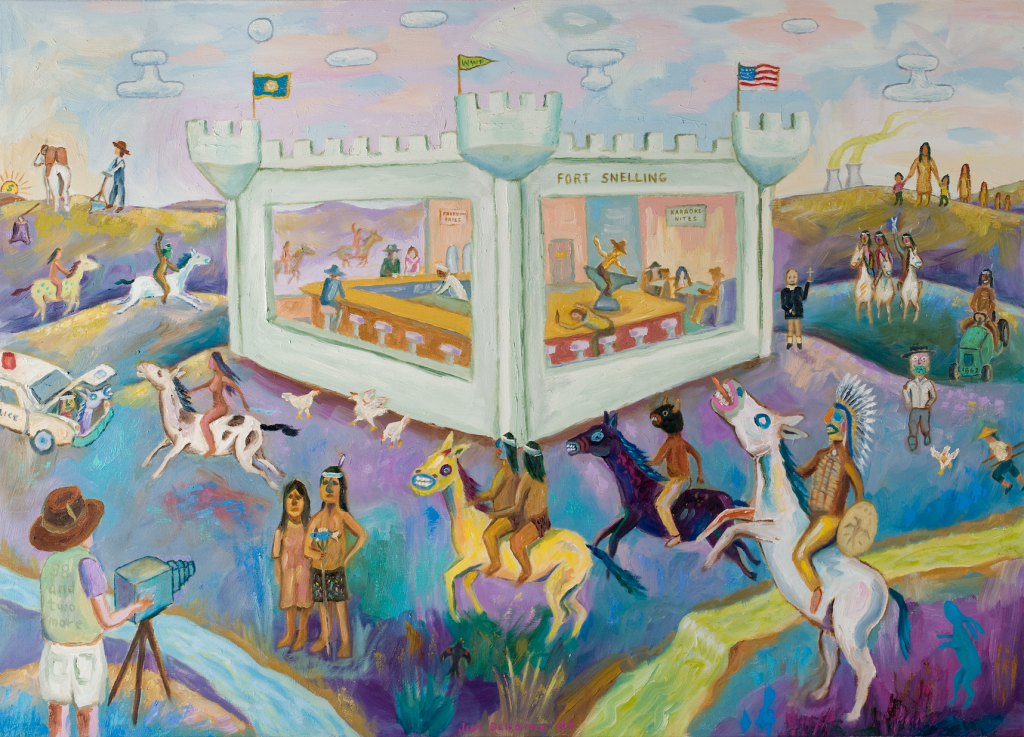
We look here to one of the most tangible and brilliant materializations of the fort and the surround in Denomie’s body of work: Attack on Fort Snelling Bar and Grill (2007). We, as viewers, enter the scene perhaps as another bird, thrust into this teeming world of insurgence, story, and near-quantum possibility. Just beyond the exact confluence of the Minnesota and Mississippi rivers—one sickened with the exploits of the factory on the far horizon, and the other clean(ish?) and flowing—we are flying through Bdote (the origin place of Dakhóta peoples) where we are invited into the life of the surround and to refuse the death of Fort Snelling (Bar and Grill).
While capturing the genocidal and historical impulses of the colonial state with precision Denomie mocks the synergies of state and capitalism. Fort Snelling was the site of colonial captivity under the nominal guise of internment and also massacre for the Dakhóta people during the US-Dakota War of 1862—a genocidal attack on Indigenous sovereignty and life (Estes, 2019). In Attack, Fort Snelling is presented incisively as the popular fast food chain, White Castle. This ironic, biting convergence reveals the vulgar frailty and absurdity of occupation. Inside the fort is death and sterility: correction through the loneliness of colonial life—where Nicole Soukup (2023) points us to Denomie’s interpolation of Edward Hopper’s Nighthawks—and the innate sickness accompanying it. A man is passed out, seemingly drunk, at the bar, another man rides a mechanical bull, a representation of the colonial fixation on producing false replicas of the life it slaughters, which frames actual life as only ever a referent. Simultaneously, the mechanical life trains the citizen to seek repeated exhilaration in the theatrical practice of scalar conquest. The fort becomes its own prison, its own death camp, replete with “freedom fries.”
However, for all of the false life, dying life, sterile life, and cosmically-small life inside, and placed in the material center of the canvas, Denomie powerfully shifts the visual center or decenters the visual plane. It is to the swell of life that exists outside of this capitalist, colonial fort that our attention and alignment are drawn. There is a flurrying swirl of movement and motion as horseback figures circle across this vivid terrain and circle the fort. Edward Curtis is a bizarre tourist here, his vest stamped with the visual stain of colonial death: “38 and two more,” an allusion to the largest (formal) mass execution in the occupying nation’s history, in which it hanged 38 Dakhóta warriors. The horse riding past Edward Curtis bears a big set of shining teeth, grinning at him, a shocking contrast to the necromanced limbless electrified hump inside the bar. A man and horse poke their heads out of the trunk of a cop car, a fuck-you gesture to the mid-20th century carceral convention in the East Phillips neighborhood by which cops literally threw Native people into their trunks (Schmid, 2023). The chickens run loose, no longer markers of starvation, and the white state agent walks down the hill, his mouth silenced with an overflowing clump of grass. This is a reference to Andrew Myrick who said, “Let them eat grass,” in response to the nation-state starving the Dakhóta people. (It is frequently told that he was the first white citizen to die, and was found with grass stuffed in his mouth [Long Soldier, 2017]). And in all of this, the horses are swarming and the fort is dying, and above the confluence a red-winged blackbird emerges, heading straight for and through the fort, as if by the time it makes contact the fort will have dissipated along with the factory emissions on the horizon line.
While we would need the space of a full-length monograph to attend amply to this single painting, we observe here multiple dimensions of the painting. First, the narrative and visually perspectival plurality of self-determination over: the ontologic “right” to attack; the material and symbolic view of the surround (the inversion); and, the conceptualization of the fort—as a brutal yet utterly ridiculous self-consuming death project. The surround is not presented through banal and ultimately colonial romantic notions of purity but rather as a real, multiple, and unresolved anti-colonial self-determinations (Harjo, 2019). As Mohammed el-Kurd (2025) argues, the people of the surround, of Palestine materially and metaphorically, are not required to be “perfect victims” in order to have claim to liberation from the death cult that is the Zionist entity and, by metaphorical (material) extension, all of empire. Denomie’s artistic danger here is that he can surgically assault genocidal brutality and absurdity, making fun of empire’s gross stupidity, as he animates a world not only against but also outside of it, that has cosmologic rights to itself.
The surround in Attack is a teeming sea of life, with currents and tides colliding and coalescing. Life swarms and floods here. “From the get-go,” writes Vicente Diaz (2016), “canoes swarmed European vessels, whose scribes marveled at the design and swiftness of such crafts that appeared to fly circles around their own ships, ships whose presence in the region linked imperial and religious crusading pursuits” (123). The surround swarms and teems, whether with horses or canoes, in its own contradictions and complexities, unanswerable and unintelligible to the fort, which desperately slaughters while crumbling. Dangerous, anticolonial art and its embedded lifeways and pedagogies, allows us to locate the dangerous metaphors of solidarity, to attune ourselves to the somewhere and everywhere that is Palestine. And to relocate, or dislocate, the centrality of the fort.
During the course of a podcast conversation with Ilan Pappé, one of the Makdisi Street co-hosts and brothers, speaking of genocidal regimes, said, “It seems to me that they’re swimming against the tide of history at this point.” To illustrate this tide—this solidarity—he referenced the recent (2025) Glastonbury festival, where there was “a crowd of 200,000 people with a sea of Palestinian flags, singing ‘Free, Free Palestine’” [emphasis added]. His metaphor continues and invites more metaphors forward in these deliberations: “There’s an association now that’s indelible…Palestine means freedom…it’s like a tidal wave…it seems to me that the tide is so powerful, I can’t see how they’re going to stop it…” (Makdisi Bros., 2025). Here we hear the history of freedom as metaphorically framed through the flood, the sea, the tide. And in the same breath, Palestine is the metaphor and material for freedom. Palestine is Freedom. Freedom is Palestine.
Conclusion: A pine cone rolls
We have undertaken this very brief look into relations of metaphor through the pedagogies that arise in anti-colonial art practices in the context of empire and its many and indeterminate surround(s). But we are not foolish. Death is everywhere. What happens to metaphor when the surround is pummeled into a graveyard of rubble by weaponry of death beyond comprehension? How can we understand the role of metaphor then and now? In A River Dies of Thirst, Darwish (2009) writes,
Smoke is rising from me and I reach out my severed hand to pick up my scattered limbs from many bodies…I am besieged by land and air and sea and language…I can see my heart, rolling like a pine cone from a Lebanese mountain to Rafah! (7)
Perhaps, and only perhaps, metaphor finds life, is life, and ceaselessly fights for life, even or especially in the most devastated of surrounds. We can see this in the principles of the thawabet, inviting us to struggle against the siege of hyper material death with the tools of metaphorical and material life. In November of 2023, Palestinian architect and artist Dima Srouji asked:
Why is it that we always think of a flood when imagining liberation? Why does it feel like time is cyclical. With the full moon and high tide upon us I think of this collection Phoenician Pigeons…Liberation comes in waves.
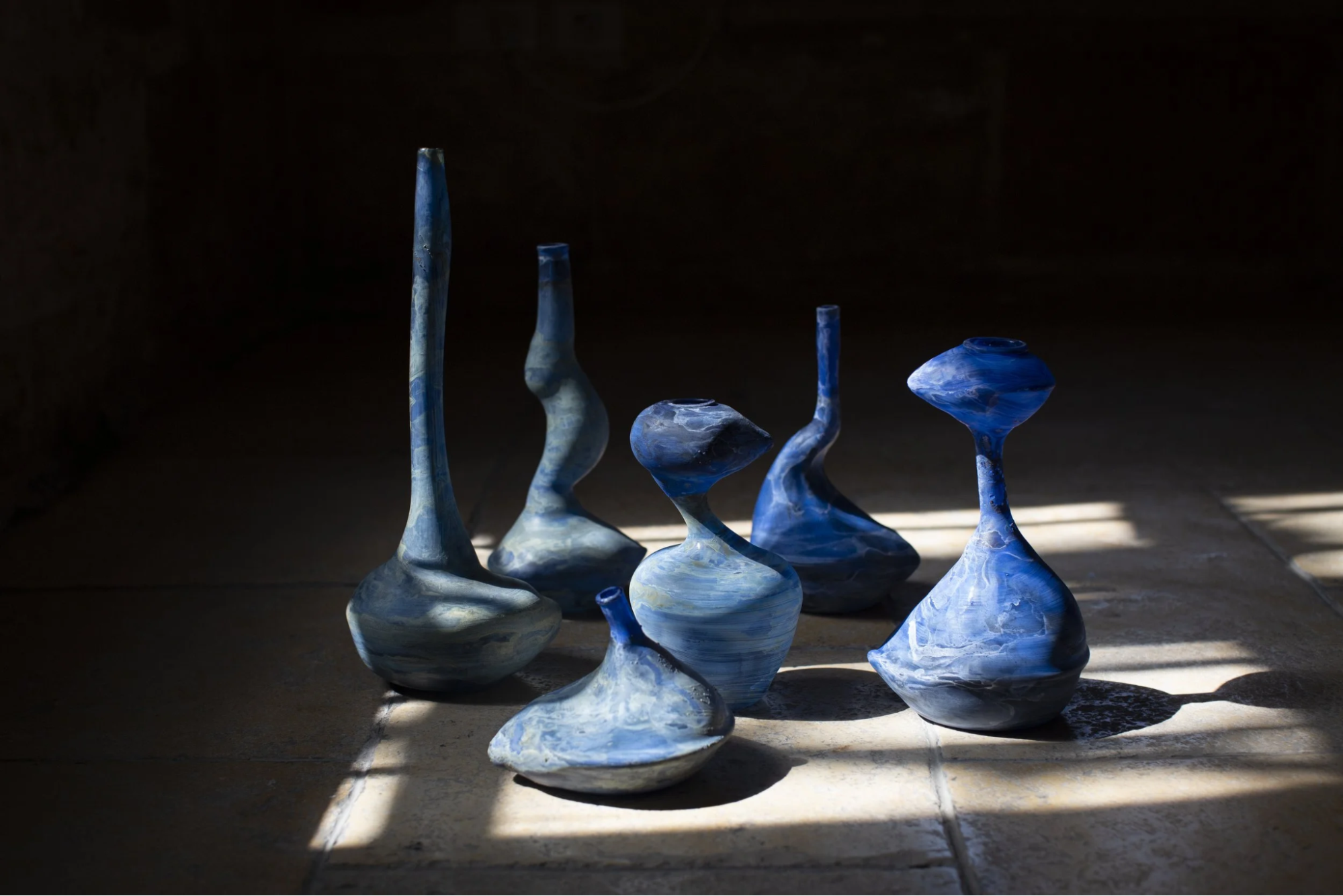
Waves, floods, and tides all rise and recede. Neither the rising nor receding is singular. Riptides, for instance, are formed in tense contradiction. The pliability of metaphor affords capacity to think and create dangerously through liberation and solidarity, through all of these water-logged and parched flows of life—demanding our dexterity in constantly rethinking the shape and movement of liberation. Demanding, in fact, that we not be experts but rather than we journey along currents, in canoes of common purpose.
Accepting the 2024 National Book Award for Poetry, Lena Khalaf Tuffaha said,
Our service is needed as writers. Our service is needed as human beings. In every room in every space. Especially where there is something to risk, where there is an opportunity to be lost, where that courage will really cost you … I don’t want to write anything that is consolation. I don’t want to console. I want us to feel a tiny fraction, a tiny fraction more than you do. (National Book Foundation, 2024)
If, as Srouji writes, liberation comes in waves, then there is no room for consolation, because liberation itself is infinite. To live by liberatory metaphor, to be in solidarity with liberating the metaphor, we stay focused. Not by consolation, or identity, or representation, but rather through shared purpose and the principles of solidarity. Through the danger of art. In order to live anti-colonial life, and in order to struggle against death in ways that refute colonial sensibilities, we are guided by and immersed in the analytic materiality of metaphor.
We come back to the flood as a principled Palestinian resistance analytic for the pedagogy of metaphor that binds us across liberation struggles, without capitulation to resolution or consolation. What worlds do we collectively imagine when the flood recedes? And how does the flood’s delta, whose contours are formed by dangerous artists, generate more metaphors? We suggest that we need more metaphors, because metaphors contain the shape and story of our liberation. What happens when we disavow a metaphor? If metaphors have martyrs and take captives, what happens to liberation when artistic pedagogy recoils in fear of censure, of solidarity? When we consent to the denial of metaphors—when our heart is not a pinecone rolling toward Home, and liberation does not come in waves—when we accept that we cannot teach and storytell the flood, we submit to being drowned. Indeed, we agree to the drowning of others. And, in this instance, drowning is the metaphor that ends metaphors.
…but if i tell
you a secret
will you believe
me?
i danced along the the spine of the shore,
built myself in the sand
until the ocean
came for me.
i folded with the waves
~“Sing (for what is left of the desert),” Tariq Luthun
Notes
- While there are immensely rich and centrally important Qur’anic, historical, geographic, architectural, and other meanings and permutations of the flood, we do not have the scholarly or cultural expertise to highlight those. We honor those deep wells of knowledge and practice from a stance outside.
- Quick-to-See Smith’s visual allusions to Pablo Picasso and his 1937 painting, Guernica, can be read here as an incisive act against the violence of appropriation. Picasso’s co-opting of the visual forms of Northern African art resulted in his commercial and critical reverence (Modiano, 2022). He was credited with rupturing the hegemony of Western art. However, Quick-to-See Smith hijacks this narrative through sly mimicry of Picasso’s mimicry, the citational style itself a critique of global imperialism, extraction, and expropriation of global Indigenous peoples. She is returning this corrupt narrative and art grifted in the colonial tradition in her trade canoe.
- Just one year before this particular flood, the Zionist entity (with the alliance of France and Britain) initiated war against Egypt in an effort to commandeer and steal another body of water: the Suez Canal. As part of their violent effort to expand empire, they conducted several massacres in Palestine. While it goes without saying that these massacres are important, our focus is on the Palestinian response to the massacres through their liberation formations. “The fedayeen’s localized struggles against Israel’s war on the Palestinian people became increasingly organized, as exemplified by the informal foundation of Fatah —which would become the preeminent Palestinian guerrilla group—in 1957, in the immediate aftermath of the 1956 war” (Winder, n.d.). Fedayeen فدائيون references those who sacrifice themselves for the larger militant liberation cause.
- We deliberately do not include images of the petroglyphs and pictographs we reference. While easy to find through an Internet search, we heed very seriously the concerns and stakes of reproduction articulated by Indigenous elders and leaders who have worked relentlessly to prevent the colonial theft and desecration of their worlds.
References
Abunimah, A. et al. [Electronic Intifada]. (2023, October 9). Breaking news and analysis on day 3 of Gaza’s Al-Aqsa flood: The electronic intifada podcast. [Video]. YouTube. https://www.youtube.com/watch?v=HcY2KlllgPo&t=1s.
Adams, G. K. (2024). Widescale destruction of cultural heritage in Gaza. Museums Association. Retrieved September 22, 2025 from, https://www.museumsassociation.org/museums-journal/news/2024/01/widescale-destruction-of-cultural-heritage-in-gaza/#
Alagraa, B. (2021, March 1). The interminable catastrophe. Offshoot. https://offshootjournal.org/the-interminable-catastrophe/
Brathwaite, E. K. (1988). The arrivants: A New World trilogy—Rights of passage / Islands / Masks. Oxford University Press.
Carlson, A. (2024, February 25). In conversation: The lyrical artwork of Jim Denomie. The lyrical artwork of Jim Denomie [exhibition discussion] Minneapolis Institute of Art, Minneapolis MN, United States.
Celilo Falls: The center of trade and heart of the region’s salmon culture for thousands of years. (n.d.). Columbia River Inter-Tribal Fish Commission. Retrieved September 22, 2025 from, https://critfc.org/salmon-culture/tribal-salmon-culture/celilo-falls/
Cesaire, 2000. Discourse on colonialism. Translated Joan Pinkham. New York: Monthly Review Press.
Danticat, E. (2010). Create dangerously: The immigrant artist at work. Princeton University Press.
Darwish, M. (2008). “Who Am I, Without Exile?” The Butterfly’s Burden. Translated by Fady Joudah. Copper Canyon Press.
Darwish, M. (2009). A river dies of thirst: Journals. Translated Catherine Cobham. Archipelago Books.
Darwish, M. (2019). Palestine as metaphor. Translated, Amira El-Zein & Carolyn Forché. Olive Branch Press.
Denomie, J. (2007). Attack on Fort Snelling Bar and Grill. [oil on canvas.] Weisman Art Museum, Minneapolis MN, United States.
Diaz, V. (2016). In the wake of Matå’pang’s canoe: The cultural and political possibilities of Indigenous discursive flourish. In Critical Indigenous Studies. Aileen Moreton-Robinson (Ed). 119-137. University of Arizona Press.
el-Kurd, M. (2025). Perfect victims: And the politics of appeal. Haymarket Press.
Estes, N. (2019). Our history is the future: Standing Rock versus the Dakota Access Pipeline, and the long tradition of indigenous resistance. Verso Books
Gargas, J. (2012). Columbia River petroglyphs show beauty of ancient art. Yakima Herald Republic. Retrieved September 22, 2025 from, https://www.heraldnet.com/news/columbia-river-petroglyphs-show-beauty-of-ancient-art/
Goodman, A. (2001, March 14). New York Times casts stones at Edward Said. Democracy Now! https://www.democracynow.org/2001/3/14/new_york_times_casts_stones_at.
Grosfoguel, R. (2011). Decolonizing post-colonial studies and paradigms of political-economy: Transmodernity, decolonial thinking, and global coloniality. Transmodernity, 1(1), 1–36.
Habashneh, K. (2023). Knights of cinema: The story of the Palestine Film Unit (N. Fattaleh, Trans.). Palgrave Macmillan.
Harjo, L. (2019). Spiral to the stars: Mvskoke tools of futurity. The University of Arizona Press.
Hammad, I. (2024). Recognizing the stranger: On Palestine and narrative. Grove Press, Black Cat.
Jamjoum, H. (2010, October 7). Interview: Palestine’s red lines of struggle. The Electronic Intifada. https://electronicintifada.net/content/interview-palestines-red-lines-struggle/9055
Jordan, J. (2005). Directed by Desire: The Complete Poems of June Jordan. Copper Canyon Press.
Long Soldier, L. (2017). 38. Whereas. Graywolf Press.
Luthun, T. (2016). Sing (For what is left of the desert). Three Poems. Tariq Luthun. Retrieved September 22, 2025 from https://drunkinamidnightchoir.wordpress.com/2016/09/15/__trashed/#more-7718
Makdisi Bros. (Creators). (2025, July 18). “The rot is very, very deep” with Ilan Pappé [Audio podcast episode]. In Makdisi Street. Makdisi Bros. https://sites.libsyn.com/495388
Maldonado-Torres, N. (2021). Prologue: Decolonial psychology as a counter-catastrophic science. In Stevens. G & Sonn, C. (Eds.), Decoloniality and epistemic justice in contemporary community psychology. vii-xiv. Springer.
Modiano, L. (2022). How much does Picasso owe to African art? The Collector. Retrieved September 22, 2025 from, https://www.thecollector.com/picasso-and-african-art/
Moreton-Robinson, E. (2015). The White possessive: Property, power, and Indigenous sovereignty. University of Minnesota Press.
Morrison, T. [Stella Adler Studio of Acting]. (2016, June 16). Toni Morrison’s final thoughts at “Art and Social Justice” [Video]. YouTube. https://www.youtube.com/watch?v=h3hhoyTbP6A.
Moten, F. & S. Harney. (2011). Against the day: Politics surrounded. South Atlantic Quarterly. 110(4), 985-988.
National Book Foundation. (November 22, 2024). Lena Khalaf Tuffaha accepts the 2024
National Book Award for Poetry for Something About Living. [Video]. YouTube. https://www.youtube.com/watch?v=Q3AYfJAf434.
Patel, S. (March 5, 2025). Eqbal Ahmad for a Time of Monsters: On the duty of intellectuals in this era of authoritarianism, genocide and pacifist pathologies. Jamhoor: Diaspora Issue 9. Retrieved September 22, 2025 from https://www.jamhoor.org/read/eqbal-ahmad-for-a-time-of-monsters
Pexa, C. (2019). Translated nation: Rewriting the Dakhóta Oyáte. University of Minnesota Press
Robinson, C. (2000). Black Marxism: The making of the Black Radical Tradition. The University of North Carolina Press.
Robinson, T. (2019). Gallery: Rock art. Confluence library. Retrieved September 22, 2025 from, https://www.confluenceproject.org/library-post/gallery-rock-art/
Said, E. (1999). Out of place: A memoir. Vintage Books, Random House.
Schmid, C. (2023). Jim Denomie: Painting story. In The lyrical artwork of Jim Denomie (pp. 45-55). Yale University Press.
Seikaly, S. [Institute for Palestine Studies]. (2025, October 23). Archiving in a time of genocide. [Video]. YouTube. https://www.youtube.com/watch?v=BqWacHjK2Y0.
Secretary of homeland security. (2025). U.S. department of homeland security. Retrieved September 22, 2025 from https://www.dhs.gov/topics/secretary-homeland-security
Smith, J.Q.S. (2004). Trade Canoe for Don Quixote. [mixed media on canvas.] Denver Art Museum, Denver Colorado, U.S.
Soukup, N. (2023). The lyrical artwork of Jim Denomie. Yale University Press.
Srouji, D. (c. 2022). Phoencian Pigeons. [glass.] Hollow Forms, Jaba’, Palestine.
Srouji, D. [@dimasrouji]. (2023, November 29). Why is it that we always think of a flood when imagining liberation? Why does it feel like this time [Photo]. Instagram. https://www.instagram.com/p/C0O__2Fs0OS/
Teaiwa, T. (2021). Sweat and saltwater: Selected works. (Katerina Teiwa, Ed.). University of Hawai`i Press.
Trade canoe for Don Quixote. (n.d.). Denver Art Museum. Retrieved September 22, 2025 from, https://www.denverartmuseum.org/en/edu/object/trade-canoe-don-quixote
U.S. Department of Homeland Security (2025). Flood. In U.S department of homeland security: Science and technology. Retrieved September 22, 2025 from, https://www.dhs.gov/science-and-technology/flood.
Winder, A. (n.d.). 1956 war: The political failure of the tripartite aggression. Interactive encyclopedia of the Palestine question. Retrieved, September 22, 2025.
Zaqtan, G. (2017). The silence that remains: Selected poems. Translated by Fady Joudah. Copper Canyon Press.

This entry is licensed under a Creative Commons Attribution-NonCommercial-ShareAlike 4.0 International license.

